What Size Solar Battery Do I Need? A Sydney Sizing Guide

Size Your Battery to Your Evenings, Not Your Bill
A home battery earns its keep between about 4 pm and 7 am, when the sun has gone and grid power is at its most expensive. That’s the window you size it for. Size it too small and you’re back on peak rates by 8 pm. Size it too big and you’ve paid for capacity your panels can’t fill for a third of the year.
The short answer: add up how much power you use from late afternoon to the next morning, then add about 10% for losses. That’s your usable battery capacity. Most Sydney homes land between 10 and 13.5 kWh. Then check your solar can fill it on a June day, when a 6.6 kW system makes only about 18 kWh.
This guide uses the same method our Sydney design team uses before recommending any solar and battery package. If you haven’t sized your panels yet, start with our guide on what size solar system you need.
Estimate your battery size
Enter your daily usage, how much of it happens after 4 pm, and your solar size. You'll get a battery size that suits your evenings and a check on whether your panels can actually fill it in winter.
It's on your bill as "average daily usage". Or divide your quarterly kWh by 91.
- Your evening and overnight use
- 12 kWh
- Power rating to look for
- 5 kW
- Solar left to charge it (June)
- 10 kWh
- Solar left to charge it (December)
- 22 kWh
A guide only. Your tariff, roof and network rules change the answer, which is why we check 12 months of meter data before recommending a battery.
Get Your Battery Sized Properly
Send us your latest bill and address. We’ll look at your usage and solar, and recommend a battery that fits your evenings and your budget.
Common Battery Sizes for Sydney Homes
These are usable capacities, which is what actually powers your home. Always compare batteries on usable kWh, not the headline number on the box.
| Usable Capacity | Evening Use It Covers | Usually Suits |
| 5 to 8 kWh | Up to about 7 kWh | Couples or small households with gas cooking and heating |
| 10 kWh | About 9 kWh | Families of 3 to 4 with split system air con |
| 13.5 kWh | About 12 kWh | Families with ducted air con, or anyone wanting blackout backup |
| 16 to 20 kWh | 15 to 18 kWh | Large homes, pools, all-electric homes or overnight EV charging |
| 25 kWh+ | 22 kWh or more | High-use homes, usually with 10 kW+ of solar and three-phase power |
A battery also has a power rating in kW, which decides how many appliances it can run at once. For most homes 5 kW is fine, but ducted air con plus an oven at 6 pm can need 8 kW or more.


How to Size a Home Battery in Five Steps
Here’s the process we follow on every battery assessment.
- Get Your Interval Data: Ask your retailer for 12 months of smart meter data. It shows your usage in 30-minute blocks, so you can see exactly how much you use after the sun goes down.
- Add Up Your Evening and Overnight Use: Total your usage from about 4 pm to 7 am on a typical day. Check a summer day and a winter day, because air con and heating shift the number a lot.
- Allow for Losses and Reserve: Batteries lose around 10% of energy charging and discharging, and many keep a small reserve. Add about 10% to your evening use. If you want blackout backup, add another 2 kWh or so as a buffer.
- Check Your Solar Can Fill It: Work out your winter surplus: your solar size × 2.8 gives June output, minus what you use during the day.
- Match the Power Rating and Inverter: Make sure the battery can deliver enough kW for your evening peak. If you already have solar, we’ll check whether your inverter can take a battery or whether an AC-coupled or hybrid setup makes more sense.
What Changes the Answer in Sydney
Battery sizing isn’t the same across the city. These are the local factors that come up most on our site visits.
- Time-of-use tariffs: Most Sydney homes on smart meters pay the highest rates from late afternoon into the evening. The more of that window your battery covers, the more it saves, so households with long evenings at home get the best return.
- Western Sydney and the Hills heat: Hot nights mean the air con runs well past sunset, pushing evening use up. Batteries also lose performance in extreme heat, so we install them out of direct sun, usually in a garage or on a shaded wall.
- Storm-prone suburbs: Parts of the Northern Beaches, Hills District and Blue Mountains lose power in summer storms. If backup matters to you, choose a battery and inverter that support it and size up slightly to carry you through.
- EVs and electrification: An EV charged overnight can add 5 kWh or more to your evening use. Switching from gas to heat pump hot water or reverse-cycle heating also shifts load, so plan for where your home will be in five years.

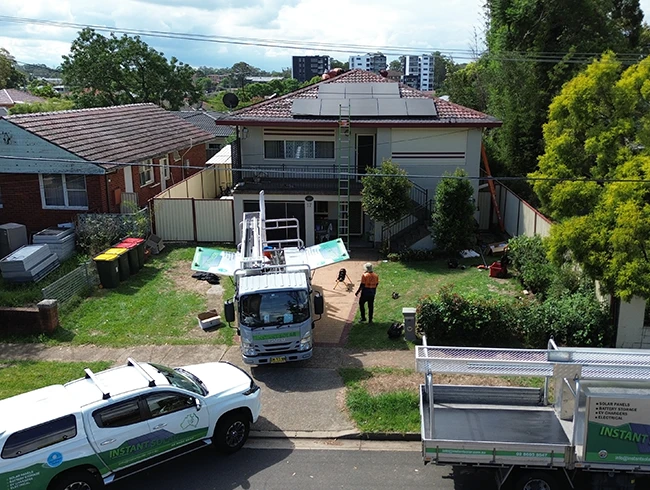
Worked Example: An Inner West Couple Adding a Battery
A couple in a Marrickville semi with a 6.6 kW system installed in 2019. Both work in the city, split system air con, gas hot water. Their meter data showed 18 kWh a day, with about 11 kWh used after 4 pm.
- Evening and overnight use: 11 kWh
- Plus 10% for losses: about 12.1 kWh
- Winter solar surplus: 6.6 kW × 2.8 = 18.5 kWh, minus 6 kWh daytime use = about 12.5 kWh
- Recommended size: 13.5 kWh usable
Their panels can fill a 13.5 kWh battery on most winter days, and easily in summer. Because their 2019 inverter isn’t battery-ready, an AC-coupled battery with its own inverter was the simplest fit, with backup for the fridge, lights and internet. They’re also planning to join a virtual power plant for the NSW incentive.
Illustrative example based on a typical Inner West home. Your numbers will differ.
Rebates That Affect Battery Size
The federal Cheaper Home Batteries Program takes a discount off eligible batteries at the point of sale. The discount is tiered by capacity, so each extra kWh beyond the first tier earns less. It also steps down over time, so the same battery gets a smaller discount the longer you wait.
In NSW you may also be able to claim the virtual power plant incentive when you connect your battery to an approved VPP. The amount depends on your battery’s size and location and changes with certificate prices.
On top of that, eligible households can spread the remaining cost with a 0% loan through the NSW Home Energy Saver Program. We confirm the current figures for every incentive in your quote.
Battery Sizing Mistakes to Avoid
- Sizing from total daily usage: A 25 kWh a day home doesn’t need a 25 kWh battery. Only the evening and overnight share matters.
- Buying more battery than your panels can fill: A 20 kWh battery on a 6.6 kW system will rarely reach full charge in winter.
- Comparing nominal instead of usable capacity: Two batteries with the same number on the box can store quite different amounts of usable energy.
- Ignoring the power rating: A big battery with a small kW output can still leave you drawing from the grid at 6 pm.
- Assuming every battery does backup: Blackout protection needs the right battery, inverter and wiring. Ask before you sign.
Frequently Asked Questions
What size battery does an average Sydney home need?
Most Sydney households use between 8 and 14 kWh from late afternoon to the next morning, so a battery with 10 to 13.5 kWh of usable capacity suits the majority of homes. Larger families with ducted air con or an EV often need 16 to 20 kWh.
Is a 10 kWh battery enough for a family of four?
Often, yes. A family of four using around 20 kWh a day typically uses 10 to 12 kWh after 4 pm. A 10 kWh battery will cover most evenings, and a 13.5 kWh battery gives more headroom on hot nights or when the air con is running.
How much solar do I need to charge a battery?
Enough to cover your daytime use and still have surplus left over. In Sydney, each kilowatt of panels produces about 2.8 kWh on a June day, so a 6.6 kW system makes roughly 18 kWh in winter. After daytime use, that often leaves 8 to 12 kWh to charge a battery.
Can I add a battery to my existing solar system?
Yes. If your current inverter isn’t battery-ready, an AC-coupled battery with its own inverter can be added alongside it. If your inverter is old or undersized, it can make sense to replace it with a hybrid inverter at the same time.
Will a battery keep my power on during a blackout?
Only if the battery and inverter support backup and are installed with a backup circuit. Some systems back up the whole home, others only essential circuits such as lights, the fridge and internet. Confirm this before you buy, because not every battery does it.
Is it better to get a bigger battery for the rebate?
Not always. The federal discount is tiered, so each extra kWh past the first tier earns a smaller discount, and a battery your panels can’t fill on a winter day will sit partly empty. Size to your evening use first, then check what the rebate adds.
Does joining a virtual power plant change the size I need?
It can. A virtual power plant can draw on your battery during grid peaks, so some households add a little extra capacity so their own evenings are still covered. Joining can also unlock the NSW battery incentive.
Get Your Free Battery Sizing Report
Our SAA-accredited designers will size your battery, solar and EV charging together, and show you what each option saves.
Why Choose Instant Solar
We are proud to help families across New South Wales gain more control over their energy.
We focus on providing a long-term result that actually does what it says on the box.
Based in Blacktown
Our own installation team
Long-term support